

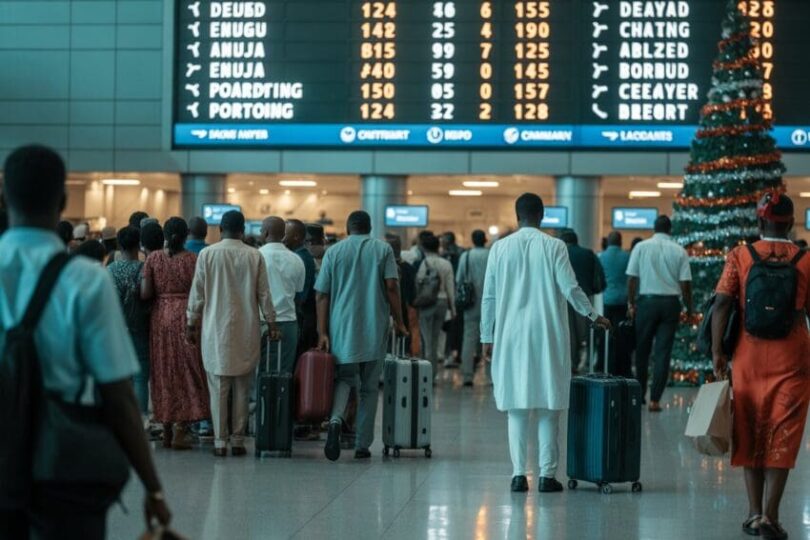
NIGERIA’s aviation industry is on life support, gasping for breath, and passengers are feeling the pinch in different ways. The recent surge in ticket prices has left many frowning, with some even calling it “airway robbery.”
Once seen as the fastest and safest way to move across the country’s vast geography, the industry is now at a crossroads. Skyrocketing ticket prices, shrinking routes, airline shutdowns, regulatory bottlenecks, and policy inconsistencies have combined to push the industry dangerously close to the edge. For passengers, flying has become unaffordable. For operators, survival is a daily struggle. For regulators and government, the questions are getting louder: can the industry still be saved, and if yes, how?
“I can’t believe they are selling a one-way ticket from Lagos to Abuja for ₦150,000,” exclaimed a frustrated middle-aged businessman passenger that humid Monday morning at the Murtala Muhammed Airport, Lagos, as tempers flared at the domestic terminal. With his suit jacket draped over his arm, he stared at the ticket price on his phone and shook his head in disbelief. “I paid less to fly to Accra last year than I’m paying to go to Abuja today,” he muttered, loud enough for others in the queue to nod in agreement.
His frustration is no longer an exception; it has become the daily reality of air travel in Nigeria. This is further exacerbated by Air Peace Chief Executive Officer (CEO), Allen Onyema’s recent declaration that the new tax laws have brought back charges that the 2020 tax laws removed. In an interview with Arise News, Onyema said the taxes include customs duties on imported aircraft, aircraft parts, and engines, as well as VAT on tickets. According to him, these taxes will further burden airlines with additional costs.
“There is VAT now on the importation of aircraft. So if you buy an aircraft of $80 million, you are supposed to pay 7.5 percent of $80 million. Do the mathematics. From money borrowed from the bank, interest rates are 30 to 35 percent. So you bring in spare parts, you pay 7.5 percent on your spare parts,” he said.
The Air Peace CEO further said that the aviation industry cannot withstand additional burdens under the new tax laws. “If we implement that tax reform, Nigerian airlines will go down in three months,” he stated.
Buttressing Onyema’s position, renowned aviation consultant and former Chairman of the Airline Operators of Nigeria (AON), Dr. Steve Ofiaju Mahonwu, notes that Nigeria’s aviation ecosystem lacks coherence, stressing that policies are often reactive rather than strategic, while long-term planning is sacrificed for short-term fixes. “There is no holistic aviation policy. We talk about national carriers, and then abandon them. We talk about airport modernisation, and then stall halfway. Everything is fragmented.”
Aviation Minister, Festus Keyamo
On December 10, 2025, the senate summoned Minister of Aviation and Aerospace Management, Festus Keyamo, alongside key industry stakeholders for an urgent meeting over the sharp rise in domestic airfares. The House of Representatives on December 11, asked the federal government to cut aviation taxes by 50 percent to curb soaring airfares.
Meanwhile, the federal government has firmly rejected claims by Onyema that Nigeria’s new tax regime will cripple the aviation industry and trigger a sharp rise in airfares. Debunking the claims, the Chairman of the Presidential Committee on Fiscal Policy and Tax Reforms, Taiwo Oyedele in a statement posted on his X handle, said the claims were misleading and did not reflect the substance of the reforms that took effect from January 1.
“Contrary to the claim that the new tax laws will hurt the industry, the reform is part of the solution, not the source of the problem. Several long-standing tax issues driving costs in the sector have been resolved in the new tax laws or are being structurally addressed,” said Oyedele.
He, however, acknowledged that the aviation sector has long struggled with multiple taxes, levies, and regulatory charges, noting that the committee had engaged extensively with airline operators. He stressed that the new laws were designed to reduce costs and improve sustainability.
“Under the new tax laws, airlines become fully VAT-neutral. Any VAT paid on imported or locally procured assets, consumables, and services will be fully claimable. Where there is excess input VAT, the law mandates a refund within 30 days or allows it to be offset against other tax liabilities. This directly reduces cost pressure and improves liquidity,” Oyedele added.
Also debunking the Onyema’s claims, the spokesperson of the Nigeria Civil Aviation Authority (NCAA), Michael Achimugu, dismissed assertions that domestic airlines pay as many as 18 different taxes, insisting that any airline making such claims had lied. He argued that the recent spike in airfares is driven largely by market forces, particularly demand and supply, especially during the festive season. “We understand that the high airfares this period are down to demand and supply. Even if we assume there are 18 taxes and that those taxes increased recently, why is it different in December?”
Achimugu added that given the level of government support extended to domestic airlines, repeated attacks on fiscal policy were unjustified. “With the kind of support domestic carriers have received, I see no reason why the government keeps getting thrown under the bus through statements like this,” he said.
Flying is now for the super-rich
The most visible symptom of Nigeria’s aviation crisis is the price of tickets. On key domestic routes such as Lagos–Abuja, Lagos–Port Harcourt, and Abuja–Enugu, fares that once hovered between N30,000 and N50,000 climbed to N100,000, N120,000, and sometimes more for one way. During peak periods, last-minute the fares exceed N150,000.
Across major routes during this festive season, the fares skyrocketed, leaving passengers with a tough decision to make amid rising insecurity. Many Nigerians choose to travel by air due to the fear of being kidnapped by bandits who seem to have taken over inter-state roads. Before the festive period, domestic air tickets on most routes hovered around N120,000. However, the fares surged by up to 150 percent, crossing the N300,000 mark on popular routes. Ticket prices were particularly high on flights to the South-South and South-East regions, which experience the highest travel volumes during the holiday season.
Between December 24 and 29, 2025, Lagos – Asaba by Air Peace was N337,500; Aero Contractors N238,452 (Dec 24) United Nigeria Airlines N399,999. Abuja – Asaba: Air Peace – N335,500 (Dec 23–28), N240,000 (Dec 29–31); United Nigeria Airlines – N335,499 – N360,499 (Dec 22–26).
Lagos – Enugu: Air Peace – N335,500 – N430,700 (Dec 28–29), Lagos – Calabar: Aero Contractors – N151,786 – N187,976 (Dec 22–24), Lagos – Benin: United Nigeria Airlines – N335,499 (Dec 22–30), additional N10,000 on Dec 31; Lagos – Port Harcourt: Air Peace – N335,500 (Dec 23–29), Lagos – Anambra: United Nigeria Airlines – N399,999 (Dec 17) Lagos – Owerri: United Nigeria Airlines – N335,499 – N499,998 (Dec 16).
For the average Nigerian, whose income has been eroded by inflation and currency depreciation, these prices are simply out of reach. Many have abandoned air travel entirely, opting for the long road journeys despite the dangers of bad roads, kidnappings, and armed robbery.
Reacting to the development, a civil servant who now travels by road despite the security risks told our correspondent that: “I have family in Owerri. Before, I could fly down for a weekend and return. Now, one return ticket is almost my monthly salary. How do they expect us to cope?”
Ironically, travel by air which is meant to offer safety and speed has become a luxury product in a country where mobility is essential for economic survival. Passengers also complain that the high fares do not even come with better service. Flight delays, cancellations, and sudden schedule changes remain common.

The weight of taxes and levies…death by a thousand cuts
Ask any airline operator what is killing the Nigerian aviation, the answer often comes quickly: taxes and levies. Nigeria is frequently cited as one of the countries with the highest number of charges imposed on airlines. From ticket sales charges and passenger service charges to landing fees, parking fees, navigational charges, terminal charges, and regulatory levies, airlines are burdened by a long list of costs—many of them dollar-denominated.
Industry insiders argue that over 30 different charges are imposed on airlines by various agencies, including airport authorities, aviation regulators, meteorological agencies, and security services. While each agency justifies its fees as necessary for operations, airlines insist that the cumulative effect is suffocating.
Speaking during an interview on ARISE News; President of the Aircraft Owners and Pilots Association of Nigeria (AOPA), and 2nd Vice President Aviation Safety Roundtable Initiative (ASRI), Dr Alex Nwuba, said the sector’s core problem remains an unsustainable cost structure that burdens both operators and passengers. He explained that multiple taxes, charges, and federal deductions were weighing heavily on the system and worsening fares. “Over 70 percent of the costs are related to charges and taxes. They are all borne by the passenger. Every layer of cost in the industry eventually falls on ticket buyers,” Nwuba said.
An airline executive, who requested anonymity, explained it bluntly: “Before we even sell one ticket, we are already in debt. Every takeoff and landing comes with overlapping levies, sudden fee increases, and little consultation before new charges are introduced. Something has to give, and that something is ticket prices.”
According to the executive, the problem is not just the number of charges but the lack of coordination and transparency. “In an industry already operating on thin margins, these costs often push airlines into losses,” she said.
Operators: We’re flying to survive, not to profit
Contrary to public perception, many Nigerian airlines are not making profits from high ticket prices. Operators insist that they are barely breaking even, and in some cases, flying at a loss just to keep their Air Operator Certificates (AOCs) active.
The cost structure of Nigerian airlines is brutal. Aviation fuel (Jet A1) remains one of the biggest expenses, often accounting for over 40 percent of operating costs. Prices fluctuate wildly, and shortages are not uncommon. Since fuel is either imported or priced in line with international markets, the weak naira has worsened the situation.
There is issue of aircraft maintenance. Despite dubbed the giant of Africa, Nigeria lacks sufficient Maintenance, Repair and Overhaul (MRO) facilities for commercial aircraft, forcing airlines to ferry planes abroad for major checks. These checks are paid for in foreign currency, adding to financial pressure.
According to experts, the surge in ticket prices is driven by a shortage of serviceable aircraft, limited seat capacity, rising operational costs, and multiple taxations. Many airlines are currently operating with fewer than 40 active aircraft, far below national demand. This Nwuba affirmed that most airlines are currently faced with capacity shortfalls.
“People think airlines are cashing out because fares are high. We are not enjoying,” he said, adding that “the truth is that if fares drop without reducing our costs, many of us will shut down within months.”
Speaking further, the AOPA president, criticised the federal government’s revenue deductions from aviation agencies, saying it fuels excessive charges that airlines and passengers absorbs. “50 percent of what the airports earn is taken away from the federal government at source to the single treasury account. This forces agencies to impose additional fees, which gets passed on to the air travellers as a tax.”
Addressing the astronomical rise in air tickets often experienced during the yuletide seasons, the aviation expert explained that the pricing pattern reflects a balancing act across the year. He stated that airlines raise peak season fares to offset losses recorded during slow periods.
“I increase my fares to fill the cost gaps and fill the revenue shortages that will result from this low demand period.”
Nwuba averred that Nigeria must rethink its aviation model to reduce fares and boost efficiency. “We must reimagine our industry; look at it from the ground up and fix many of the challenges that are surmountable.” He maintained that without structural change, rising costs will continue to weaken operators and leave passengers paying the price, further limiting the country’s connectivity and economic potential.
Pointing to difficulty accessing affordable financing, the ASRI VP 2 said: “Local banks often view airlines as high-risk ventures, offering loans at interest rates that make long-term sustainability impossible. Without government-backed credit facilities or structured leasing support, airlines are left to fend for themselves in a hostile financial environment.
Nigeria’s aviation history is littered with the wreckage of failed airlines. From Okada Air to Oriental Airlines, Afrijet Airline, Chanchangi, Sosoliso, ADC and more recent collapses like First Nation and Med-View’s long-haul ambitions, the pattern is familiar: rising costs, policy shocks, debt accumulation, and eventual shutdown.
Will the industry survive?
While security challenges on the ground ironically increase demand for air travel, its affordability limits who can fly. This imbalance threatens the industry’s social relevance. The question begging answer remains: will it survive in its current situation?
Experts opined that the prolonged high fares could permanently shrink passenger numbers, stressing that more airline collapses could reduce competition, pushing prices even higher; skilled professionals—pilots, engineers, cabin crew—may seek opportunities abroad, deepening the talent drain.
Despite repeated setbacks, the Nigeria aviation has proven to be resilient, as it continues to play a vital role in national integration and economic activity. Survival, however, will require deliberate and painful reforms. According to Dr Mahonwu, saving Nigeria’s aviation industry will not happen by accident. It demands coordinated action across government, regulators, operators, and financiers. “First, there must be an urgent review and harmonisation of taxes and charges. Reducing duplication and introducing a single-digit, transparent levy structure could significantly ease cost pressures without compromising safety.
“Access to affordable financing is crucial. Government-backed credit schemes, aircraft leasing support, and lower interest rates for aviation projects can give airlines breathing space. Third, local capacity must be developed. Functional MRO facilities, trained manpower, and improved airport infrastructure can reduce foreign exchange exposure and operational risks.”
He continued, “There must be policy consistency. Aviation is a long-term business; sudden policy shifts scare investors and destabilize planning. Government must commit to a clear, stable aviation roadmap and stick to it.
Finally, airlines must improve corporate governance and financial discipline. Regulators must streamline operations and eliminate inefficiencies. Government must resist the temptation of headline-grabbing projects without structural backing.